



Buying tools before defining problems
A chatbot licence, an image generator and an AI add-on for the notes app, and no clear problem any of them solve. Starting with a tool and hunting for a use case is the most common and most expensive AI mistake.
Practical AI consulting from Jaipur for SMEs, eCommerce brands and growing teams: a workflow audit, an AI readiness assessment, tool selection, a working proof of concept and an implementation roadmap. We find where AI saves real hours or money in your business before anything is built.
Advice that is not tied to any AI vendor.
We recommend the model or automation tool that fits your use case, budget and team, then build it into the systems you already use.
5
Readiness dimensions
2-4wk
Prototype build
30d
Support after launch
Why AI initiatives fail
Most failed AI projects are not technology failures. They are strategy failures: the wrong problem, the wrong tool, or no plan for the team that has to use it.
A chatbot licence, an image generator and an AI add-on for the notes app, and no clear problem any of them solve. Starting with a tool and hunting for a use case is the most common and most expensive AI mistake.
Automating a bad process makes it fail faster. If customer data sits in four spreadsheets and two WhatsApp groups, an AI layer inherits every inconsistency. The process has to work first.
The tool is deployed, the team does not use it, and it quietly dies. People need to see how it helps their own work, not just hear that the founder read about it online.
Many requests for AI are really requests for automation: a Zapier flow, a WhatsApp API integration, a simple routing rule. A deterministic tool is often cheaper, faster and more reliable.
Pasting customer personal data into public chat tools, or publishing AI-written content with no human check. India's DPDP Act and global data rules create real liability that is easy to miss.
If nobody knows how long a task takes today, nobody can prove AI made it faster. Without a measured before-state the ROI case is never made and the project loses its budget.
What we do
Every engagement starts with the audit. The rest follows only where the numbers say it is worth it.
Every repetitive process mapped across support, content, data entry, reporting, onboarding and inventory. Each one assessed for AI fit, current time cost and likely impact, then ranked.
Starting point for every engagement
Data quality and access, process documentation, team digital literacy, current tool stack and budget, scored across five dimensions. Gaps are fixed before implementation, so it succeeds.
Gaps found before you spend
GPT and Claude APIs, Gemini, n8n, Make, Zapier, Whisper, ElevenLabs or open-source models. The choice is driven by your budget, your team and the use case, not by who pays referral fees.
Tool-agnostic
A working prototype of the highest-priority use case: a support triage bot, a product description generator, a demand forecast or lead scoring. Tested on your real data before you commit.
Working prototype, not slides
A phased plan: what gets built first, what later and what not at all. Training plan, data preparation, integration dependencies and success measures for each phase.
Phased, team-inclusive plan
AI search, recommendations, automated reports and assisted customer service inside your website, CRM, store or custom platform, using the OpenAI, Anthropic and Google APIs and n8n, Make or Zapier.
Shopify and WooCommerce in-house
AI use cases
Use cases we audit, prototype and build most often, grouped by the team that feels the difference.
Support is usually the biggest block of repetitive work in a growing business, and the easiest place to keep a human in control.
Tools often used
Inbox triage
Messages sorted by intent and urgency, routed to the right person.
Draft replies
Answers drafted from your FAQs and policies, reviewed by your team before sending.
Chatbot for common questions
Order status, sizing, delivery and returns answered on the site or WhatsApp, with a handover to a person.
Review responses
Replies to customer reviews drafted in your brand voice.
Large catalogues and weekly campaigns create writing work that follows a pattern, which is exactly what language models handle well with the right structure.
Tools often used
Product descriptions in batches
Copy generated from structured product attributes, in a consistent voice, with a human review round.
SEO meta descriptions
Titles and descriptions written for each product and collection, checked for length and duplicates.
Ad copy variations
Headlines and primary text drafted for each campaign and audience, then refined by your marketer.
Image and video assets
Concept images and voice-overs with tools such as Midjourney, FLUX and ElevenLabs, where licensing allows.
Sales teams lose hours to notes and first drafts. AI handles the first pass so people spend their time on the conversation.
Tools often used
Call notes to briefs
Discovery call recordings transcribed with Whisper and turned into a structured project brief.
Proposal first drafts
Proposals drafted from the brief and your past work, ready for a human edit.
Lead scoring
Leads ranked from your CRM history so the team calls the warmest ones first.
Follow-up drafts
Personal follow-ups drafted from the call notes and the last message.
Reports compiled by hand every Monday and stock decisions made on instinct are two of the clearest cases for automation and forecasting.
Tools often used
Scheduled performance reports
Data pulled from GA4 and the Meta Ads API into a report that is ready on a schedule.
Demand forecasting
Reorder signals from historical sales and seasonality, ahead of festive and sale periods.
Data entry and clean-up
Invoices, forms and order details extracted into your sheets or ERP and checked for gaps.
Internal knowledge search
Staff ask questions in plain language and get answers from your own documents.
AI readiness assessment
AI projects fail where the foundations are weak. We score your business on five dimensions, show where the gaps are and fix them first, so the implementation does not stall halfway.
Data quality and access
Is the data the use case needs complete, consistent and reachable by an API?
Process documentation
Is the process written down well enough for a machine to follow it?
Team digital literacy
Can the people who will use it adopt it, and who owns it day to day?
Existing tool stack
Which systems it must connect to: CRM, store, ERP, WhatsApp, sheets.
Budget
Build cost, running cost of API usage, and the time your team can give.
Choosing the right approach
Not every problem needs a language model. Part of the audit is matching each use case to the simplest approach that does the job reliably.
| Approach | Rule-based automationZapier, Make, n8n | Language model via APIGPT, Claude, Gemini | Custom ML modelForecasting, scoring |
|---|---|---|---|
| Best for | Fixed, repeatable steps between apps | Reading, writing, summarising and sorting text | Predictions from your own history |
| Needs your own training data | No | No, it works from prompts and context | Yes, structured historical data |
| Output | The same every time | Varies, needs checks | A score or forecast with a margin of error |
| Running cost | Low, per task | Pay per use of the API | Hosting and periodic retraining |
| Human review | Rarely needed | Yes, for anything customer-facing | Spot checks against actuals |
| Example | New order to sheet to WhatsApp alert | Support reply drafts | Reorder quantities before a sale season |
Swipe to see the full table
Many good solutions mix all three. The audit tells you which part needs which.
Ask about your caseData privacy and DPDP
The question most AI projects skip. We flag the legal exposure before we build, not after, and design every workflow with India's Digital Personal Data Protection Act as the baseline.
Personal data removed before it leaves
Names, emails and phone numbers stripped or pseudonymised before text goes to a third-party AI API.
Consent and agreements
Customer data sent to an AI provider only with consent and a data processing agreement in place.
Private models for sensitive work
Self-hosted open-source models such as Llama or Mistral where the data should not leave your servers.
A human in the loop
AI-written content and replies checked by a person before customers see them.
Tools we work with
We pick from the whole field for each use case. Third-party API costs are billed to you at cost, with no mark-up.
Language models
OpenAI
GPT models via API
Claude
Anthropic Claude API
Google Gemini
Gemini API
Perplexity
Search-grounded answers
Automation
n8n
Self-hostable workflows
Make
Visual scenarios
Zapier
App-to-app automation
Flowise
LLM flows and chatbots
Retrieval and data
LangChain
LLM application framework
Pinecone
Vector search
Qdrant
Vector search, self-hosted
Hugging Face
Open models and datasets
Voice, image and open source
Whisper
Speech to text
ElevenLabs
Text to speech
Midjourney
Image generation
Llama
Open-source LLMs
Outcomes
Measured against the baseline set before the work started: hours saved, costs avoided and timelines shortened.
GrowthSystems
Performance agency, Jaipur
14 hrs
Saved per week on copy and reports
Zero
Manual report compilation
Ad copy generation went from an 8-hour weekly task to a 2-hour review. Client reports are generated automatically every Monday, so the account manager reviews for 20 minutes instead of compiling for 6 hours.
Impulsebyte
Our own agency operations
60%
Less time drafting proposals
Structured
Briefs from call recordings
Discovery calls are transcribed with Whisper and turned into structured briefs in minutes. Proposal drafting time fell by 60% using the Claude API with project context.
NIJ by Indiloom
Ethnic wear D2C brand
4 days
Against 3 to 4 weeks by hand
400
Product descriptions
A Claude API pipeline with structured product attributes as input wrote all 400 product descriptions in 4 days, including human review rounds, with a consistent brand voice and SEO meta descriptions.
How we work
Each stage ends with a decision you make with the facts in hand, so you never pay for a full build before the idea has been proven.
Week 1
A 2 to 3 hour structured interview with your operations and team leads. Every repetitive process mapped, timed and costed. No AI recommendations yet.
Week 1 to 2
Readiness scored on five dimensions, use cases ranked by ROI and complexity, and a business case for the top three. A working document, not a locked PDF.
2 to 4 weeks
A working prototype of the highest-ROI use case, built with real tools on your real data or a representative sample. You see the results before committing.
6 to 16 weeks
Full build, integration and team training. Prompts, workflows and maintenance documented, and the before and after measured.
A typical engagement
Client work
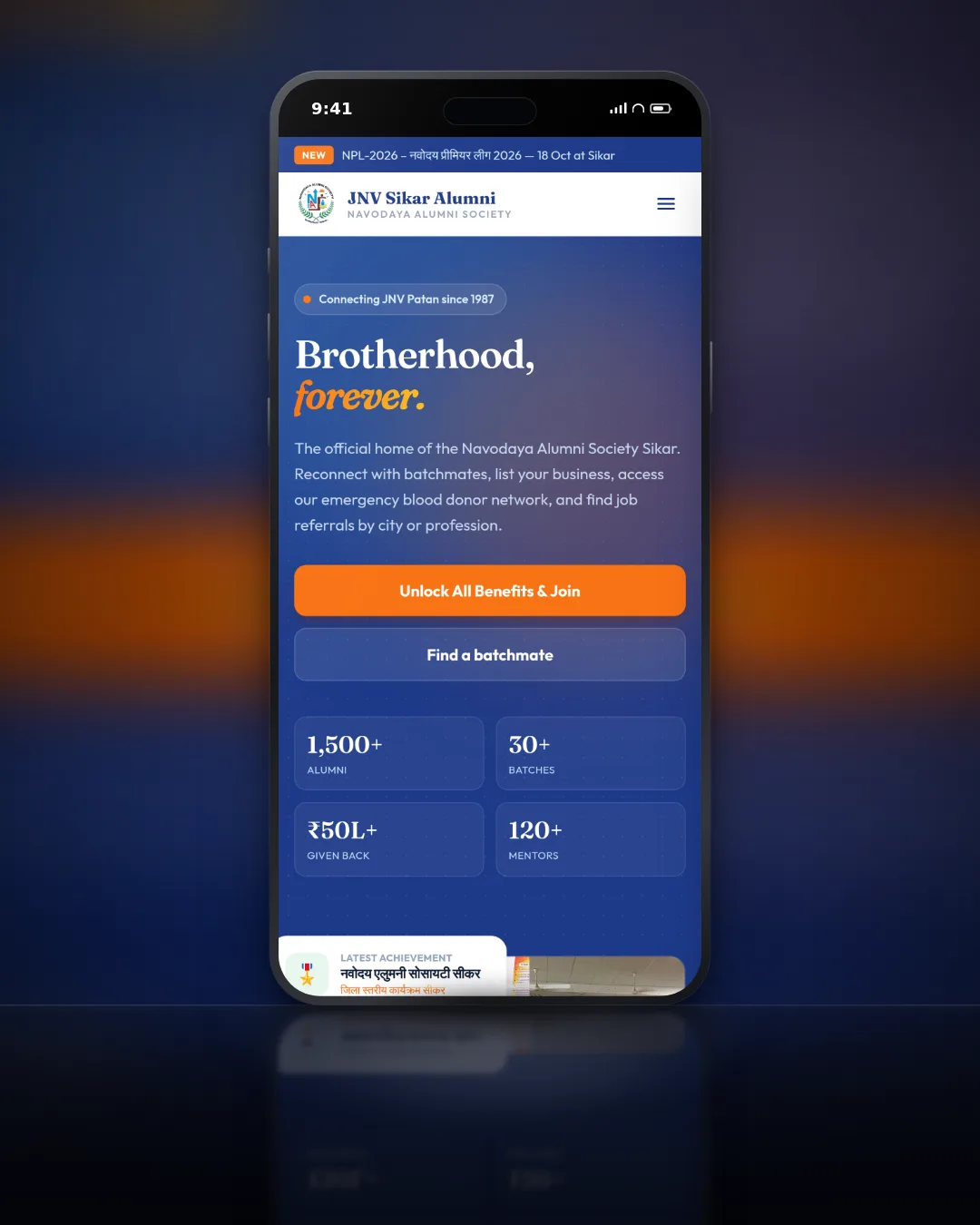
A full public-facing alumni site plus a 3-tier role-based admin system in CI4 with Student, Super Admin, and Batch Coordinator roles.
Read the case study3 Live
User Roles
9
Admin Pages
8
Public Pages
Education / Non-Profit · CodeIgniter 4
3 Live user roles
SaaS & Products · Laravel
Wholesale / Fashion · WordPress
Automated enquiry flow
EdTech & Aviation · EdTech
18 issues found
See every case study
Shopify, WordPress and custom builds, with the brief, the work and the result.
View all workPricing
Start with the audit. It tells you whether AI is the right investment at all before you spend on building anything.
AI Audit and Opportunity Report
Find out where AI pays off before you spend on building.
Rs 18K to 35K
1 to 2 weeks
Audit and Proof of Concept
The full audit plus a working prototype of your best use case.
Rs 60K to 1.5L
4 to 6 weeks
Full Implementation
Approved use cases built into the systems you use every day.
Rs 1.5L +
6 to 16 weeks
All prices exclude GST. Third-party API costs (OpenAI, Anthropic and others) are separate and passed through at cost.
Not sure where AI fits yet?
Book a free discovery call. We talk through your processes and tell you honestly whether an audit is worth it for your business.
FAQ
Not sure if AI is right for your business yet? Ask us in the form below and you will get a straight answer.
Often more than for a large company. Small teams have the most to gain because staff time is limited and repetitive work takes a bigger share of it. A ten-person team spending three hours a day on tasks AI can do in minutes is a big opportunity. The workflow audit shows quickly whether the return justifies the cost at your size.
It depends on the use case. Language models such as GPT, Claude and Gemini are already trained, so you work with them through prompts and your own documents. Forecasting, recommendations and lead scoring do need structured historical data. The readiness assessment shows whether you have enough, and we will not recommend a data-hungry solution your data cannot support.
A subscription is a tool in a browser tab. We identify which processes AI can improve, build it into the tools your team already uses, write the prompts that give reliable output for your case, and train the team to use it every day. The gap between having AI access and saving real hours each week is the workflow around the tool.
Personal data such as names, emails and phone numbers should not go to a third-party AI API without consent and a data processing agreement. We design workflows that strip or pseudonymise personal data first, use India's DPDP Act as the baseline, and recommend self-hosted open-source models where the data is sensitive. We flag legal exposure before building.
Then you found out for the price of a prototype, not a full build, which is the point of it. If AI cannot reach the quality you need, we say so. Often the prototype shows a modified use case that does work. Either way we document what worked and what did not, so the learning stays with you.
Yes. AI product search, personalised recommendations, generated product descriptions, a support chatbot and assisted review replies can all be built into Shopify or WooCommerce. We build eCommerce stores ourselves, so the AI layer and the store integration are handled by one team rather than two agencies.
There is no single answer, which is why we stay tool-agnostic. The choice depends on the task, the quality needed, data sensitivity, running cost and what your team can maintain. Sometimes the right answer is a plain automation in n8n or Zapier with no language model at all. The audit report explains each recommendation.
Third-party API usage from providers such as OpenAI or Anthropic is billed separately and passed through at cost, with no mark-up. The opportunity report estimates running costs for each use case alongside the time saved, so you can see the monthly cost before you approve a build.
The AI audit and opportunity report usually takes one to two weeks. It starts with a structured interview of two to three hours with your operations and team leads, followed by mapping, readiness scoring and the business case for the top opportunities.
Yes. Every implementation includes team training and documentation of the prompts, workflows and maintenance steps, plus 30 days of support after launch. Change management is part of the roadmap, because a tool the team does not adopt saves nothing. Ongoing monitoring is available on a retainer if you want it.
The map pack is ranked on three things Google names publicly, and only two of them are yours to change. Here is what that means in practice for a Jaipur business, and which of the usual local SEO advice is a waste of your time.
Most of the risk in a WooCommerce to Shopify move is not the product data. It is the URL map, the things that were plugins and now have to be rebuilt, and in India the payment gateway, which does not come across at all.
Shopify handles a lot of technical SEO for you and leaves a specific set of problems it cannot fix. Here is which pages to fight for, the duplicate URL trap every store has, and what to do about supplier product copy.
AI consulting
Tell us about your business and the work that eats your team's week. We reply within 2 hours with what we would look at first.
Free discovery call (30 min)
We understand your processes and goals, with no commitment.
Fixed-fee proposal
Audit scope, timeline and price in writing.
Proof before the full build
You see a working prototype before you commit to implementation.
A few lines on your business and the processes you would like to improve are enough to start.