
01
D2C commerce app
Catalogue, cart, Razorpay checkout, order tracking, and push notifications for back-in-stock items and offers. Connected to Shopify or your own backend over a REST API.
Like: Royal Viraasat, live on Google Play
Custom mobile app development in React Native from our team in Jaipur: D2C shopping apps, booking platforms, alumni and community apps, dealer portals and field tools. Designed in Figma, built in TypeScript, connected to the backend you already run and published to Google Play and the App Store.
Built in-house, not passed to freelancers.
The same team scopes, designs, builds and publishes your app, and stays reachable on IST hours while it is in the stores.
2
Stores, one codebase
5
Steps to launch
100%
Code you own
What we build
Each one maps to something we have already built, or to components we have shipped on live platforms. Nobody learns on your project.
Catalogue, cart, Razorpay checkout, order tracking, and push notifications for back-in-stock items and offers. Connected to Shopify or your own backend over a REST API.
Like: Royal Viraasat, live on Google Play
Multi-day itinerary booking, vendor listings, an availability calendar, payments, booking history and WhatsApp notifications for customers.
Like: MakeEasyBooking
Member directory, roles for admins, members and batch coordinators, events, announcements and profiles. Based on real alumni platform work in CodeIgniter 4.
Like: JNV Sikar Alumni
B2B ordering, dealer territories, stock visibility, tiered price lists, order history and sales rep tracking, synced with your ERP over an API.
Custom B2B scope
Course catalogue, video lessons, a quiz engine, progress tracking, certificates and an instructor dashboard, on a multi-role architecture.
Like: FliqhtIQ architecture
Location tracking, task assignment, attendance, job-site photo uploads, daily reports and supervisor approvals for construction, logistics and field service teams.
Like: Maluka Earthmovers scope
Why React Native
React Native renders real native components on Android and iOS from one TypeScript codebase. For most business apps that means one build, one set of fixes and one budget instead of two.
| What matters | React NativeWhat we build in | Separate native appsKotlin and Swift | Website in an app shellWebView wrapper |
|---|---|---|---|
| Codebases to maintain | One, for both stores | Two | One, plus the website |
| User interface | Native components | Native components | Web pages inside the app |
| Camera, location, push | Yes, through native modules | Yes | Limited |
| Offline behaviour | Designed per screen | Designed per screen | Usually none |
| Best for | Commerce, booking, community and B2B apps | Heavy graphics, AR, deep OS features | A quick store presence |
Bare workflow
We set up React Native without a managed layer for production apps, so every native module is available when the app needs it.
TypeScript throughout
A typed codebase catches mistakes before they reach a phone, and is easier for your next developer to pick up.
Ready for current Play rules
Builds meet Google Play's 16 KB memory page size requirement for apps that target Android 15 and later.
Included as standard
These are not add-ons on a quote. Payments, push notifications, store submission and a proper handover are part of every app we build, whatever the plan.
Talk through your appReact Native, bare workflow
Full access to native modules on Android and iOS.
TypeScript throughout
Fewer runtime bugs and a codebase the next developer can read.
REST API integration
Connected to your CodeIgniter, Laravel, Shopify or third-party backend.
Firebase push notifications
Order status, offers and event alerts on both platforms.
Razorpay payments
UPI, cards, net banking and EMI: the payment stack Indian customers expect.
Google Play submission
App signing, AAB build, store listing, screenshots and submission.
Source code and documentation
Full repository, README, setup guide and API reference.
Your backend
The most common setup we build: your products, members or orders stay where they are, and the app reads and writes them through an API. If your backend has no API yet, we add one.
What you run today
The API layer
Your app
Customers see the same stock, prices and orders as on your site.
Tech stack
A small, proven set of tools we use on every project, so your app is built the same careful way as the ones before it.
Core framework
React Native
One codebase, native UI on both platforms.
TypeScript
Typed code from the first screen.
Zustand
Or Redux, for app state.
Backend and services
Laravel
Or CodeIgniter 4, for the REST API.
Shopify
Storefront and Admin APIs for commerce apps.
Firebase
Push notifications and authentication.
Razorpay
Payments inside the app.
Store delivery
Google Play
Play Console listing and release tracks.
Apple App Store
App Store Connect and TestFlight.
fastlane
Repeatable builds and store uploads.
Store launch
Store review is where many first apps stall. We prepare a complete listing so reviewers have nothing to ask for, submit the build, and track the review until the app is live.
App signing
Signing keys created and handed to you, never kept only by us.
Production build
An Android App Bundle for Play, and an iOS archive for the App Store.
Store listing
Screenshots, description, category and content rating prepared.
Privacy policy
A privacy policy page and data safety answers for the listing.
Build process
Every app follows the same path. A typical timeline is 10 to 16 weeks, depending on the features in scope.
Weeks 1 to 2
Feature list, user flows, API contract, platform choice and budget confirmed. A clickable prototype comes before any code.
Weeks 2 to 4
Onboarding, home, listing, detail, cart or booking, checkout, profile and admin views, with two revision rounds.
Weeks 4 to 11
Screens, navigation, state, payments, push notifications and every endpoint connected, with auth and error handling built in.
Weeks 11 to 13
Device testing across Android versions, plus onboarding, checkout, error states, offline behaviour and deep links. You get a test report.
Weeks 13 to 16
Signing, production builds, store listings, submission and review tracking until the app is live.
A typical full app project
Case study
A luxury ethnic fashion brand. We scaffolded a fresh React Native 0.77.2 app to meet Google Play's 16 KB page size rules, built the shopping flows and published it to Google Play.
RN 0.77.2
Framework version
16 KB
Page size ready
Android
First platform
Published
On Google Play
What we delivered
Ownership
At handover everything is yours. We keep no rights and no access unless you ask us to maintain the app.
Source code
Signing keys
Store listings
Developer accounts
Client work
A custom WordPress catalogue with Shopify-style URLs, live AJAX product search, WhatsApp enquiry buttons, and a full SEO module.
Read the case studyAutomated
WhatsApp Enquiries
Manual to Automated
Real-time
Search Findability
None to Instant
Improved
Google Indexing
Not indexed to Indexed
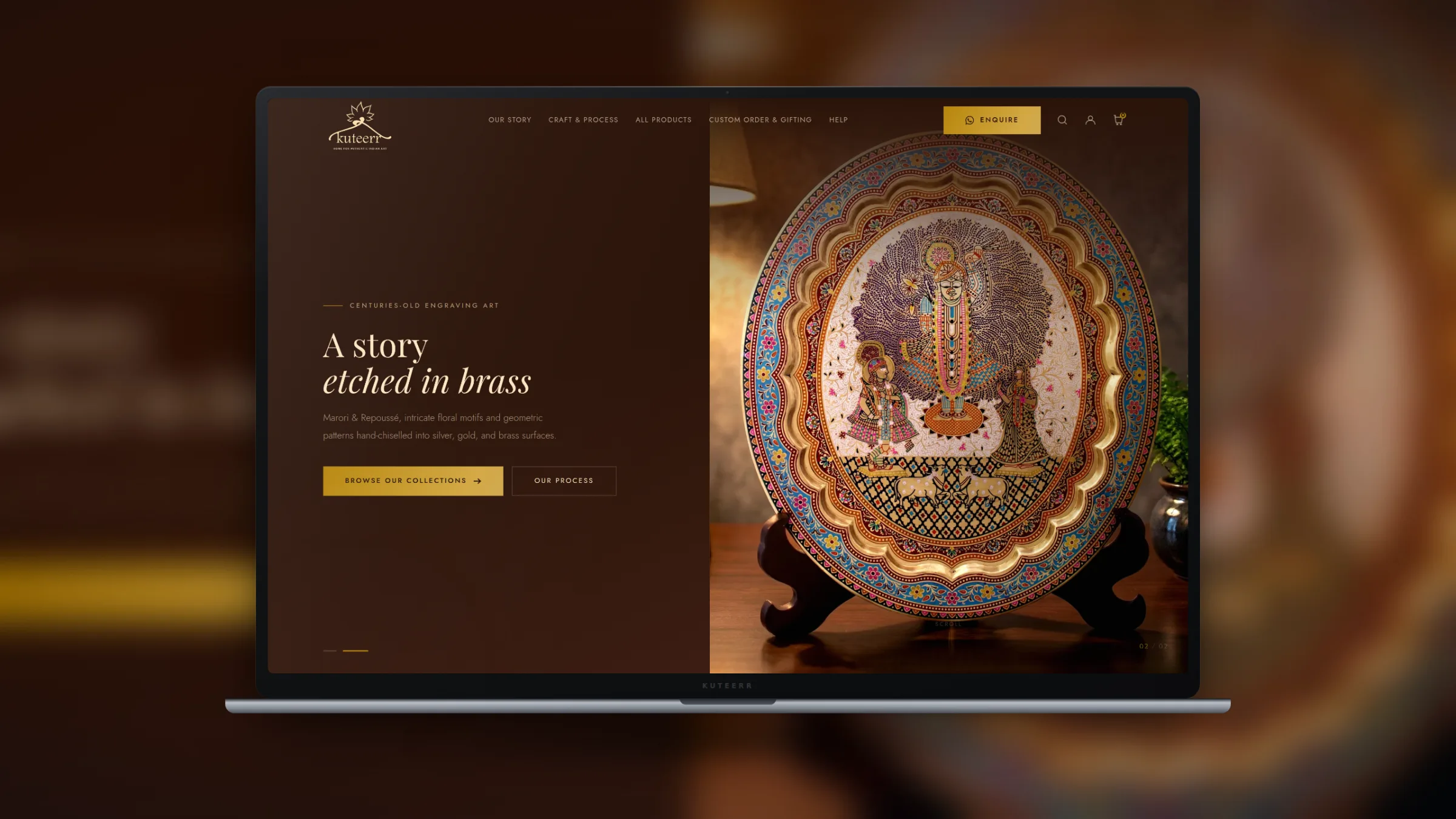
Handicrafts & Decor · Shopify
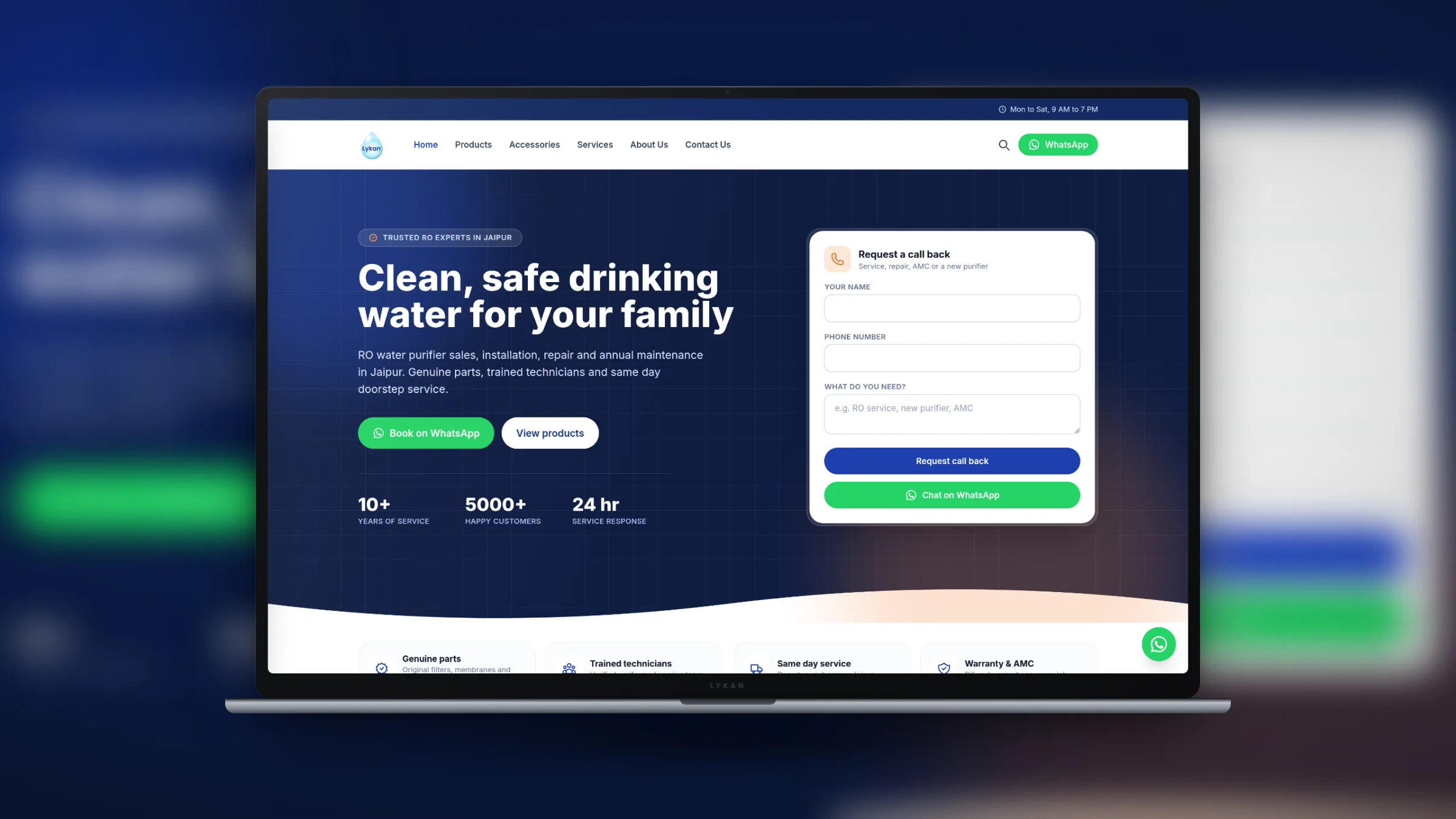
Home Services · Laravel
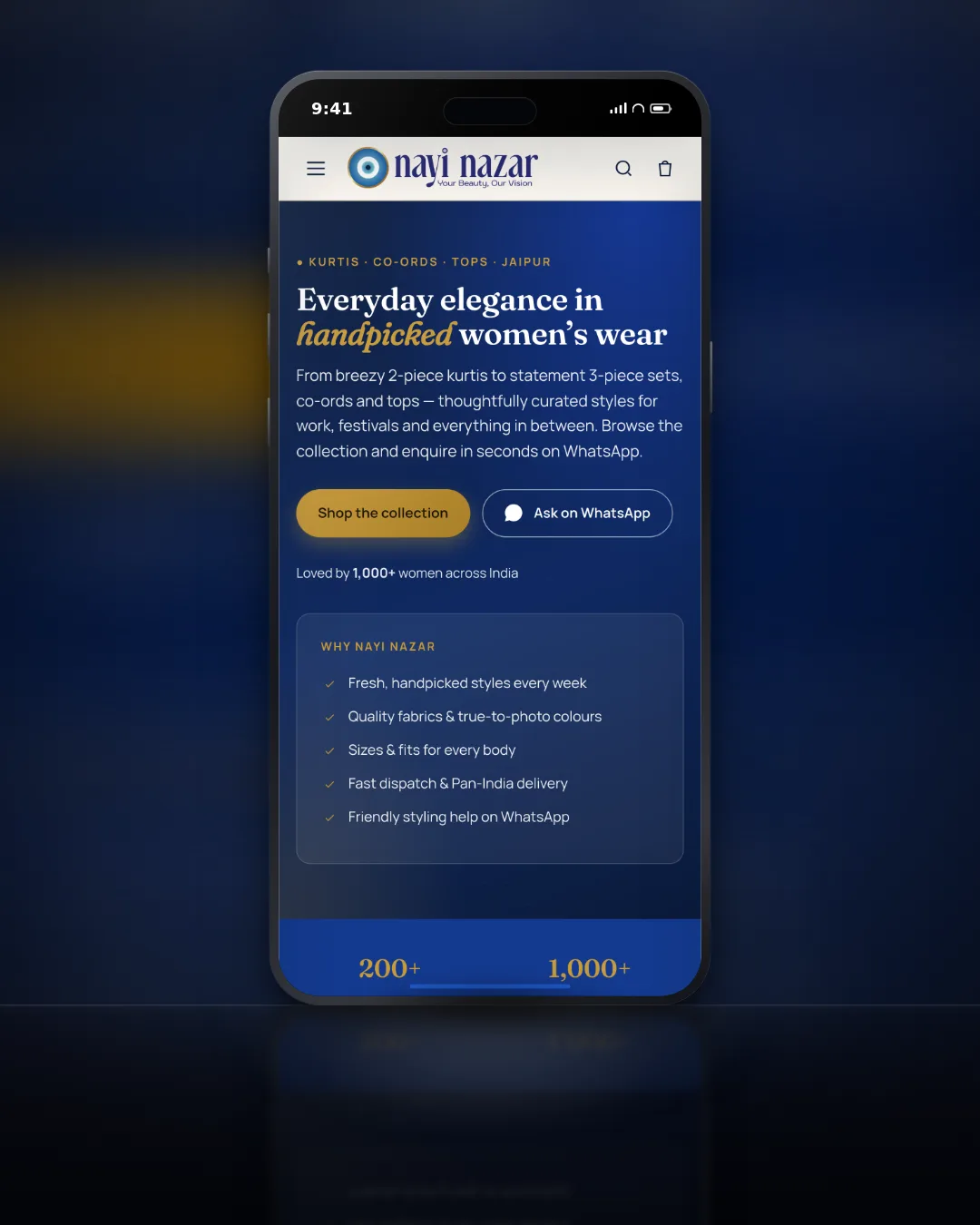
Fashion & Apparel · WordPress
Automated whatsapp enquiries
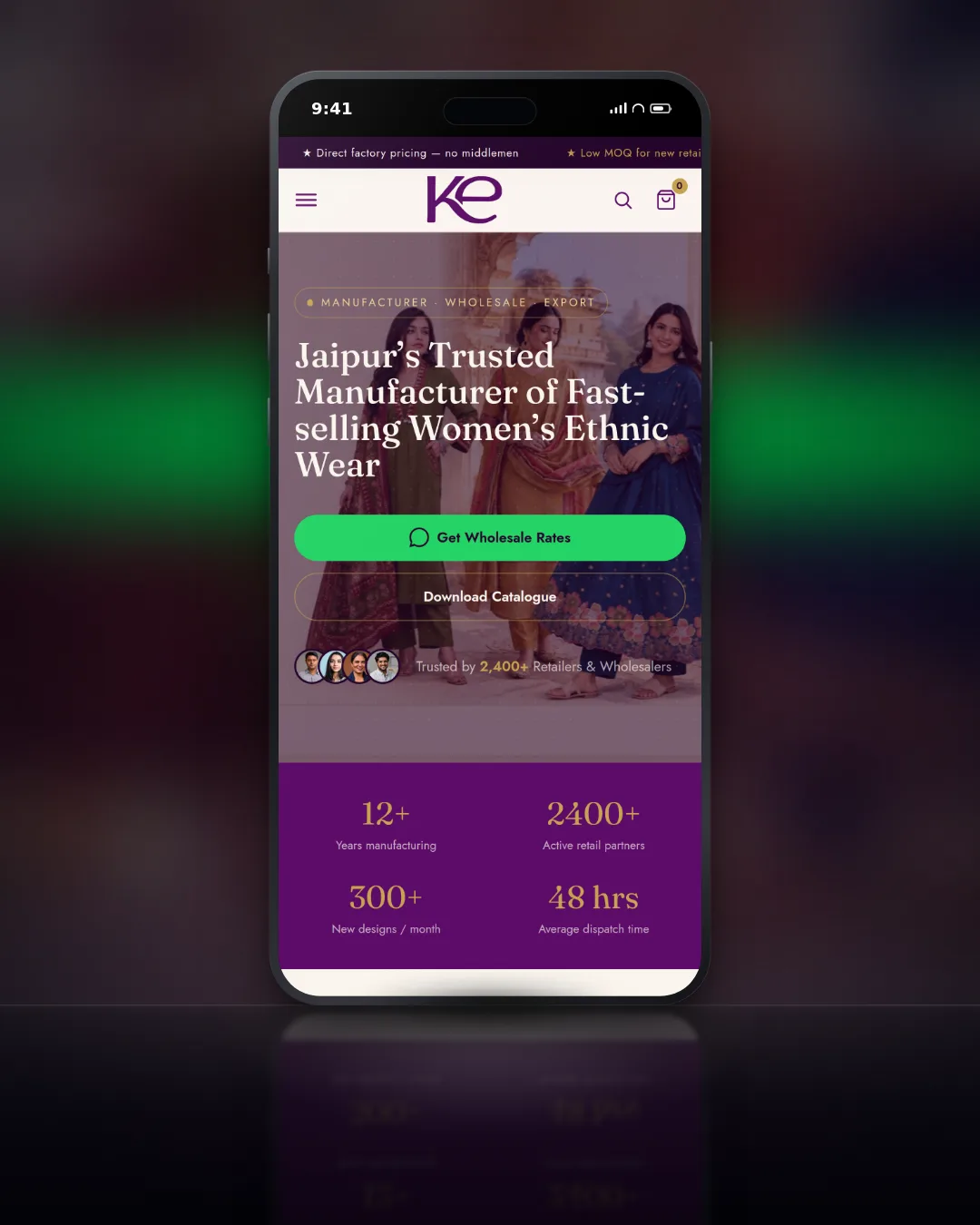
Wholesale / Fashion · WordPress
Automated enquiry flow
See every case study
Shopify, WordPress and custom builds, with the brief, the work and the result.
View all workPricing
Every app is scoped on its own. These ranges come from projects we have delivered or are building, and you get a fixed price in writing before work starts.
MVP App
Core flows only, to get a first version into users' hands.
₹80K to ₹1.5L
8 to 12 weeks
Full App
A complete app for customers and your team, on both stores.
₹1.5L to ₹3.5L
12 to 16 weeks
Enterprise App
For apps that run part of your operations.
₹3.5L +
16 to 24 weeks
All prices exclude GST. A fixed-price scope document is provided before work begins.
Not sure which range your app falls in?
Book a free 30-minute scoping call. We go through the flows you need and tell you which range it lands in.
FAQ
If your question is not here, put it in the form and we will answer it straight.
Both. React Native produces one codebase that runs natively on Android and iOS. Many clients start with Android for faster iteration and a lower store cost, then add iOS in a second phase or at the same time. We handle both store submissions, including App Store Connect and TestFlight for iOS.
For most business apps, such as shopping, booking, community and B2B ordering, one React Native codebase gives native screens on both platforms with one team and one budget. Separate Kotlin and Swift apps make sense for heavy graphics, AR or deep operating system features, and we will say so if your app needs that.
We use a bare React Native setup for production apps. It gives full access to native modules and lets us control the native build directly, which is how we made Royal Viraasat meet Google Play's 16 KB memory page size requirement without workarounds.
Yes, this is the most common setup. We connect the app to your CodeIgniter, Laravel, WordPress or Shopify backend through a REST API. If your backend has no API endpoints yet, we add them. For Shopify stores we use the Storefront API, which we have integrated directly on Royal Viraasat.
A typical project takes 10 to 16 weeks. An MVP with core flows only usually takes 8 to 12 weeks, a full app with multiple roles, payments and an admin dashboard 12 to 16 weeks, and an enterprise app with ERP integration and offline mode 16 to 24 weeks.
Typically 3 to 7 business days for a new app on a new Play Console account, and usually 1 to 2 days for later updates. We submit with a complete listing, screenshots, privacy policy and content rating, so the review is not held up by missing information.
A short brief: what the app does, who uses it and the main user flows. Competitor apps you like help. You do not need a full specification, because we ask the questions that build one. We also need access to your backend API, or we build it, and a Google Play developer account in your name.
Yes. You get full repository access at handover, and you own the code, the store listings, the signing keys and the developer accounts. We keep no rights or access after handover unless you engage us for ongoing maintenance.
Yes. From the build stage you get a new build every week on your own phone, through TestFlight on iOS or an installable build on Android. You see real progress, test flows yourself and send feedback while changes are still cheap to make.
The map pack is ranked on three things Google names publicly, and only two of them are yours to change. Here is what that means in practice for a Jaipur business, and which of the usual local SEO advice is a waste of your time.
Most of the risk in a WooCommerce to Shopify move is not the product data. It is the URL map, the things that were plugins and now have to be rebuilt, and in India the payment gateway, which does not come across at all.

Shopify handles a lot of technical SEO for you and leaves a specific set of problems it cannot fix. Here is which pages to fight for, the duplicate URL trap every store has, and what to do about supplier product copy.
Start your app
Tell us what the app should do and who will use it. We reply with the flows we would build, a timeline and a fixed-price range.
Free 30-minute scoping call
We go through the flows, users and backend you have today.
Fixed-price proposal
Scope, screens, timeline and price in writing before any work starts.
Weekly builds, then launch
Test on your own phone every week, then we publish to the stores.
A few lines on what it does and who uses it is enough to start.